
Loading Experience
Linked Patient Learning
Loading Experience
Your drug works.
Your clinical data is perfect.
Your patients are still failing.
Here's why:
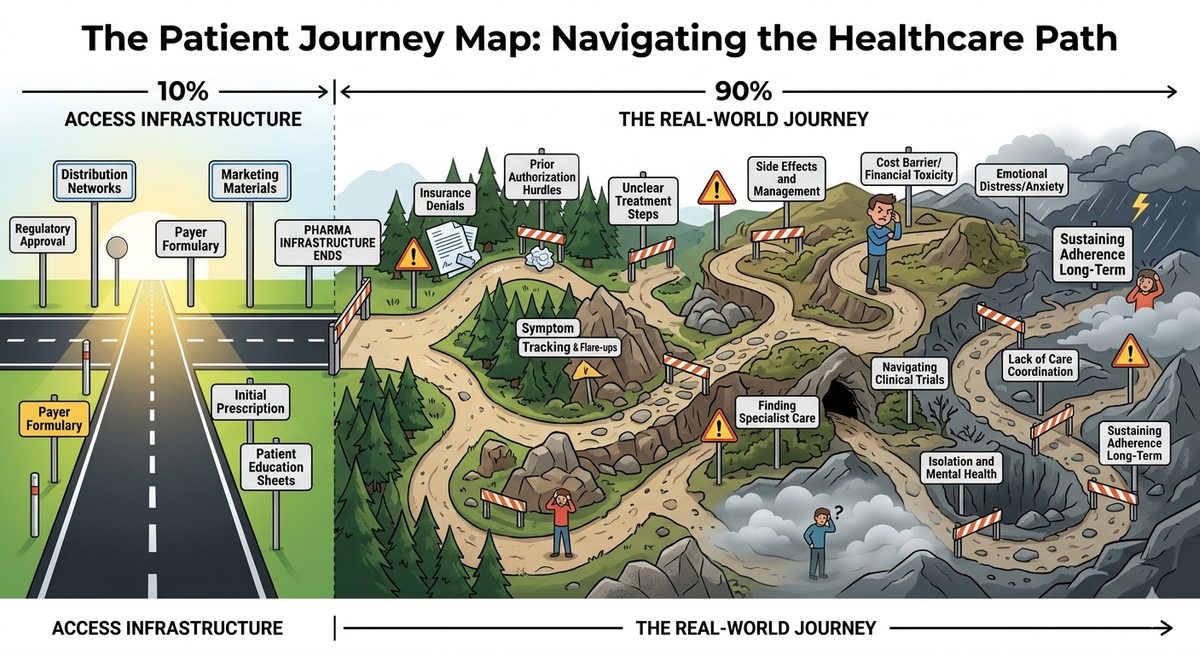
You're solving for the wrong 10% of their journey.
The 10% You Optimize For
Getting the drug to the patient.
Market access. Payer negotiations. Prior authorizations. Hub programs. DTP platforms. Same-day telehealth. Home delivery.
Billions spent compressing weeks to hours. Removing friction from the transaction. Making it seamless togetthe medication.
You have mastered this.
And it matters. Patients who cannot access therapy cannot benefit from it.
But access is 10% of the patient experience.
The 90% You Ignore
Succeeding on the drug once it arrives.
It's 2:17 AM on a Sunday. Your patient is terrified of the side effects on page 47. The medication is sitting on their kitchen counter. The hub closes at 5 PM Friday. The call center opens Monday at 9 AM.
Does your $300M launch infrastructure help them in this moment?
It's week six. They feel nauseated after every injection. They don't know if this is normal. They don't want to bother their doctor. They are quietly considering stopping.
Does your patient support program detect this before they ghost the therapy?
It's month four. They are managing this condition plus three others. Seven different specialists. Four medications. Multiple insurance hoops. They are exhausted by the chaos.
Does anyone help them coordinate their care?
This is the 90%.
The daily decisions. The behavioral tipping points. The moments of fear and doubt and overwhelm that determine whether patients stay on therapy or discontinue.
And most pharma companies treat this as someone else's problem.
Here Is What Happens When You Ignore the 90%
The drug arrives. Perfect fulfillment. Seamless delivery.
The patient starts therapy.
Then week three hits. Or month two. Or the first bad side effect.
And the infrastructure built for the 10% has nothing to offer for the 90%.
No systematic engagement. No behavioral support. No ecosystem integration. No one tracking the micro-signals that predict discontinuation.
Just a patient, alone, making a decision your launch team will see six months later in the data.
This is why many rare disease launches miss first-year adoption targets.
Not because of access. Because of the 90%.
The Infrastructure for the 90%
If you want patients to succeed on therapy, you need infrastructure designed for sustained engagement, not transactional efficiency.
Three layers:
Strategic Framework- Clarity on roles and why.
Operational Playbook- Templates and processes for how to execute consistently and scale.
Measurement & Improvement- The ability to track impact and optimize over time.
This infrastructure enables:
Continuous support beyond the transaction.The 2 AM answer when patients are scared. The behavioral nudges before they discontinue. The community connections that sustain them through difficult months.
Ecosystem integration.Meeting patients where they already are—in advocacy organizations, online communities, diagnostic journeys—instead of asking them to come to another platform.
Behavioral intelligence.Monitoring engagement patterns and sentiment to identify risks before patients disappear. Tracking what actually predicts success, not just whether the prescription was filled.
Care coordination.Helping patients navigate the 7+ specialists, multiple medications, and insurance chaos that defines their reality.
This is not theory.
This is what separates launches that hit targets from those that stare at disappointing adoption curves and wonder what went wrong.
The Choice
You can continue optimizing for the 10%. Make the transaction faster. The fulfillment smoother. The delivery more seamless.
Your patients will get the medication.
And many of them will still fail on it.
Or you can build infrastructure for the 90%.
The part of the journey where patients succeed or give up. Where behavior change happens or doesn't. Where your R&D investment either pays off or gets wasted.
The companies who understand this are not asking "How do we deliver faster?"
They are asking "What does the patient need to succeed once the drug arrives?"
And they are building infrastructure designed to answer it.
P.S.Getting the drug to patients is necessary. But it is not sufficient. The diagnostic odyssey for rare diseases averages 4.7 years. Once patients finally reach treatment, they need more than a delivery confirmation. They need support for the 90% you're ignoring.
Written by
Liza Prettypaul-Lodhia
Share your details and we'll send you the playbook.