
Loading Experience
Linked Patient Learning
Loading Experience
Your hub contract is up for renewal. The dashboards look great: 95% enrollment completion, 48-hour benefit verification, excellent call resolution.
But your persistence is still declining.
Here's why: Your patient engagement platforms are measuring vendor performance. You need to measure patient outcomes.
Before you auto-renew, use these 12 vendor evaluation questions. They're not designed to expose vendor failures—they help you understand what your healthcare engagement solutions CAN do versus what you need to build yourself. Most vendors aren't bad. They just weren't designed for cross-ecosystem visibility.
These questions reveal where to upgrade contract terms, where to build supplemental infrastructure, and where you need entirely new capabilities.
The Analytics Problem
Your patient engagement programs send you program performance metrics:
What their measurement and analytics don't show:
Your vendors optimize their piece. No one was designed to optimize for patient continuity across the pieces.
12 Vendor Evaluation Questions
Section 1: Cross-Handoff Data Visibility
1. Can your patient engagement platform show me a specific patient's complete journey—enrollment, fills, foundation applications, field support—in a single timeline?
What you're testing: Whether the vendor has cross-handoff data visibility or only tracks their own touchpoints.
2. When a patient doesn't fill their second prescription, how long does it take your system to detect it and alert us?
What 90% looks like: Alert within 5-7 days, before discontinuation becomes likely.
3. Can your healthcare engagement solution tell me which patients are at highest risk of discontinuation in the next 30 days—and why?
What you're testing: Predictive analytics capabilities vs. reactive program performance metrics.
Section 2: Root Cause Measurement Beyond Enrollment
4. Of patients who discontinued last quarter, what percentage discontinued due to: coverage loss, access barriers, financial issues, clinical reasons, versus unknown?
What 90% looks like: Systematic categorization showing specific percentages for each category.
5. Can your measurement and analytics show how many patients experienced coverage disruption in the 90 days before discontinuation?
What you're testing: Whether the vendor tracks coverage continuity or only coverage status at touchpoints.
6. What's your process for identifying patients who switched from copay assistance to foundation support—and why does that matter?
What you're testing: Whether the vendor recognizes financial stress signals that indicate coverage changes.
Section 3: Cross-Vendor Handoff Analytics
7. How many patients who enrolled through the hub never filled their first prescription—and do you know why?
What you're testing: Visibility across the hub-to-pharmacy handoff.
8. When foundation approval takes longer than expected, does therapy continue uninterrupted—and how do your measurement and analytics track this?
What 90% looks like: Proactive bridge protocols triggered when approval timelines exceed therapy start needs.
9. Can your platform identify patients receiving hub support, pharmacy services, AND foundation assistance simultaneously—and show if those patients have better or worse persistence?
What you're testing: Multi-vendor engagement impact analysis requiring cross-handoff data visibility.
Section 4: Proactive Intervention Measurement
10. If a patient's Medicaid is up for redetermination next month, does your healthcare engagement solution alert us before coverage lapses?
What you're testing: Proactive coverage monitoring vs. reactive verification at touchpoints.
11. When your patient engagement platform detects a potential issue—missed refill, coverage change, access barrier—what triggers an intervention, and how quickly?
What 90% looks like: Automated triggers based on patient signals, not scheduled touchpoints.
12. Can your measurement and analytics show the difference in persistence rates between early intervention (before missed fill) versus reactive recovery (after they already stopped)?
What you're testing: Whether the vendor measures intervention-level effectiveness, not just program-level outcomes.
How to Score and Interpret Vendor Responses
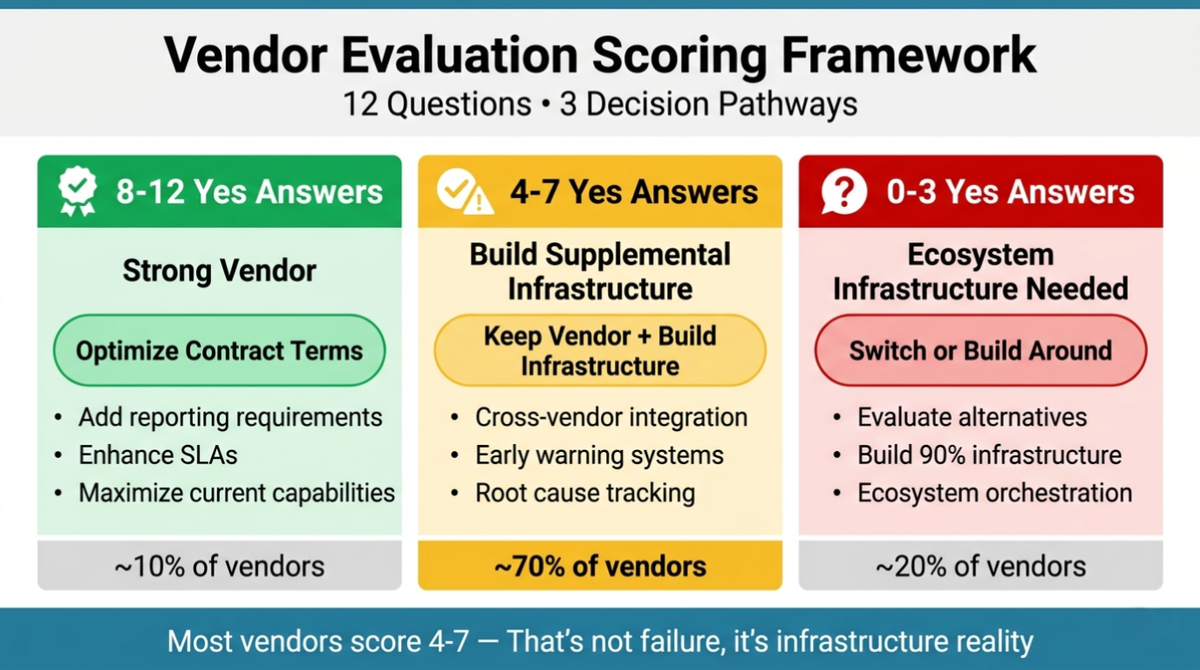
Give your vendor 1 point for each "yes" (they can do this with their current platform) and 0 points for each "no" (they can't, or would require significant customization).
8-12 Yes Answers: Strong Vendor, Optimize Contract Terms
Your healthcare engagement solution has robust measurement and analytics capabilities. You have cross-handoff data visibility or strong integration potential.
Your action: Add contract language requiring:
You likely don't need new infrastructure. You need better utilization of what your patient engagement programs can already deliver.
4-7 Yes Answers: Capable Vendor, Build Supplemental Infrastructure
Your vendor has solid program performance metrics for their piece. The gaps are in cross-ecosystem visibility—which isn't what they were designed to provide.
Your action: Keep the vendor for what they do well (their core services). Build supplemental infrastructure to:
This is the most common scenario. Good vendors doing their job well, but you need additional infrastructure layer for the 90%.
0-3 Yes Answers: Infrastructure Gap Vendor Can't Fill
Your patient engagement platform is optimized for activation and enrollment metrics. The measurement and analytics capabilities for sustained support, cross-handoff visibility, and proactive intervention don't exist in their system design.
Your action: Two options:
Option A: Switch to vendor with stronger 90% capabilities (if scoring 8+ exists in market for your needs)
Option B: Build 90% infrastructure that works ACROSS your vendor ecosystem:
Most vendors score 2-4. That's not vendor failure. They were built for their specific function, not ecosystem orchestration.
What This Means for Your Vendor Evaluation
This framework isn't about finding "bad" vendors. It's about understanding what your patient engagement programs were designed to deliver versus what the 90/10 Framework requires.
Most vendors excel at:
Most vendors weren't designed for:
Understanding this distinction helps you make the right renewal decision:
Before You Renew
Use your vendor's score to guide your decision:
8+ score: Negotiate contract enhancements requiring them to deliver the analytics capabilities they already have. Add SLAs around cross-handoff metrics, early warnings, and root cause reporting.
4-7 score: Renew for core services. Budget for supplemental infrastructure that bridges the gaps—unified data layer, early warning systems, proactive intervention protocols.
0-3 score: Evaluate whether a different vendor scores higher, or whether you need to build 90% infrastructure that orchestrates across your existing vendor ecosystem regardless of individual vendor capabilities.
The real question: "If persistence declines 10% next year, will these patient engagement platform dashboards tell me why?"
Your vendor's answers to these 12 questions tell you whether the answer is yes—or whether you need infrastructure beyond what any single vendor provides.
Linked Patient Learning helps biopharma companies conduct vendor evaluation, interpret vendor capabilities honestly, and build 90% infrastructure that delivers cross-ecosystem visibility, early warning systems, root cause attribution, and proactive intervention protocols—working with or around your existing patient engagement programs.
Contract renewal coming up?
Schedule a Vendor Analytics Assessment: We'll help you score your vendors on these 12 questions, interpret what the results mean, and design the right solution—whether that's enhanced contract terms, supplemental infrastructure, or ecosystem-level build.
Written by
Linked Patient Learning
Share your details and we'll send you the playbook.