
Loading Experience
Linked Patient Learning
Loading Experience
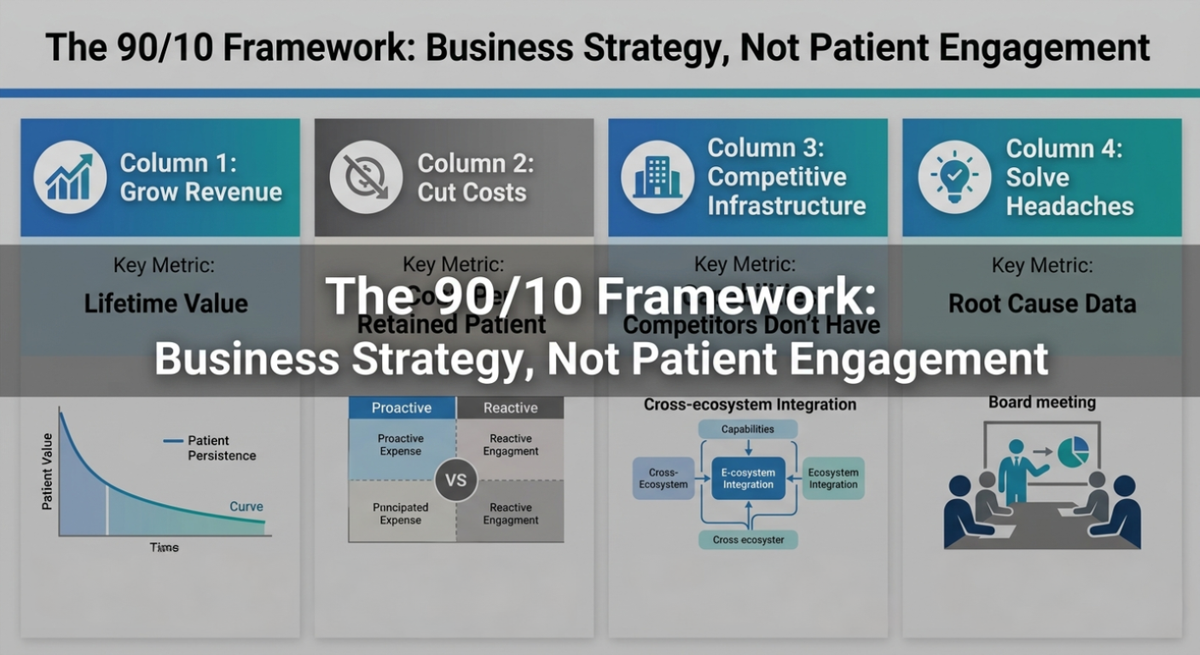
Most pharma teams position patient support as a cost center.
The 90/10 Framework makes it a competitive moat.
Here's why the companies building infrastructure for the 90% will outperform on the metrics your CFO and board actually care about.
What the 90/10 Framework Actually Is
The 10%: Activation moments where pharma excels—enrollment, benefit verification, first fill, initial training.
The 90%: Sustained support between touchpoints—daily decisions at home, refill coordination, side effects at 11pm, life disruptions, coverage gaps.
The problem: Your infrastructure was built for the 10%. Patients live in the 90%. And that's where persistence—and revenue—is won or lost.
What "Building for the 90%" Actually Means
This isn't a new vendor or single platform. It's redesigning your patient support infrastructure to answer one question: "What's happening to patients between our touchpoints—and can we intervene before problems become discontinuation?"
Operationally, this means:
Unified patient journey visibility - Connecting data across your hub, specialty pharmacy, foundation, and field reimbursement so you see handoff failures, not just individual vendor performance.
Early warning detection systems - Identifying coverage gaps, financial barriers, and access disruptions in days, not weeks. Infrastructure that flags when a patient's Medicaid is up for redetermination, when copay-to-foundation switches signal coverage change, when appointment cancellations indicate access problems.
Root cause tracking - Categorizing every discontinuation by actual reason (coverage loss, access barrier, financial, clinical) not generic "non-adherence." Building the data infrastructure your board and payers actually need.
Proactive intervention protocols - Systems that trigger support when warning signals appear, not after patients have already stopped therapy.
This is ecosystem mapping, cross-vendor integration, new metrics infrastructure, and intervention redesign. Not a single purchase decision—a strategic build.
Why This Matters to Your P&L: The 4 Business Cases
1. Grow Revenue: Persistence Is Lifetime Value
Consider this scenario for a specialty therapy at $100K annually:
Traditional infrastructure scenario (10% optimized):
90% infrastructure scenario (continuity optimized):
Hypothetical impact per 1,000 patients: $40M revenue difference.
The companies building infrastructure that maintains therapeutic continuity through coverage disruption, access barriers, and daily treatment decisions will demonstrate superior persistence rates—and capture lifetime value competitors lose in the 90%.
2. Cut Costs: Proactive Is Cheaper Than Reactive
The cost math is straightforward:
Detecting coverage gaps in 5 days and intervening while patients are still engaged costs significantly less than 4 weeks of attempted recovery after patients have already stopped therapy.
Single coordinated interventions cost significantly less than multiple uncoordinated vendor attempts across hub, specialty pharmacy, and foundation.
Scale this across coverage disruption from the One Big Beautiful Bill Act (10 million losing coverage by 2034 American Medical Association) and the cost advantage compounds.
The companies that can detect and intervene early will operate patient support at substantially lower cost per retained patient than those relying on reactive recovery.
3. Build Infrastructure Competitors Can't Replicate
What you CAN build with the 90/10 Framework:
Cross-ecosystem visibility: Map your complete patient journey—from hub enrollment through specialty pharmacy fills through foundation applications through field reimbursement support. Identify where handoffs fail. Build integrations that make the invisible visible.
Coverage continuity tracking: Build systems that monitor Medicaid redetermination cycles, track ACA subsidy eligibility changes, flag when patients switch from copay cards to foundation assistance (early signal of coverage change). Detect disruption before it causes discontinuation.
Root cause infrastructure: Create taxonomy and tracking for why patients discontinue—not just that they did. Build the data systems that let you say "of our Q4 discontinuations, 35% were coverage-related, 20% were access barriers, 15% were financial" instead of "non-adherence increased."
Intervention triggers: Design protocols that activate support when warning signals appear: coverage gap detected = immediate financial counseling; appointment cancellation pattern = access barrier investigation; copay-to-foundation switch = coverage change support.
This infrastructure doesn't exist in any vendor's standard offering. Your hub, specialty pharmacy, and foundation each optimize their piece. No one optimizes the connections between them.
Building for the 90% means building what the market doesn't sell: unified patient journey infrastructure that maintains therapeutic continuity across the gaps.
That's sustainable competitive advantage.
4. Solve the Headache Preventing Growth
The board meeting problem:
Your launch exceeded enrollment targets. Your persistence rates are declining. The board asks why.
You can't answer—because your metrics track operational performance (the 10%) not patient outcomes (the 90%).
The payer negotiation problem:
Value-based contracts require demonstrating real-world therapeutic continuity. You have enrollment data. Payers want persistence through coverage disruption, access barriers, treatment complications.
You're negotiating with activation metrics while they demand outcomes data.
The competitive differentiation problem:
When two therapies have similar efficacy, the one that can prove superior real-world persistence wins formulary positioning. But you can't prove what you don't measure.
The 90/10 Framework solves the headache:
You stop defending unexplained discontinuation. You start demonstrating measurable advantage.
The Strategic Question
Most pharma commercial teams ask: "How do we improve patient engagement?"
That's the wrong question. It leads to more touchpoints, better scripts, enhanced education—optimizing the 10%.
The right question: "How do we maintain therapeutic continuity through the disruptions that happen in the 90%—and prove it?"
That question leads to infrastructure that:
This isn't patient engagement strategy. It's business strategy that happens to improve patient outcomes.
The companies building 90% infrastructure now will report better persistence, demonstrate stronger outcomes, negotiate from strength, and explain their competitive advantage.
Those optimizing the 10% will report declining metrics they can't explain—and wonder why.
Linked Patient Learning helps biopharma companies build patient engagement infrastructure that delivers measurable business outcomes—revenue growth, cost reduction, competitive differentiation, and board-ready performance data.
Schedule a 90/10 Infrastructure Assessment:
We'll map your current patient journey, identify the 3 highest-risk handoff failures where patients are lost in the 90%, and quantify the P&L impact of building infrastructure to close those gaps.
Written by
Linked Patient Learning
Share your details and we'll send you the playbook.