
Loading Experience
Linked Patient Learning
Loading Experience
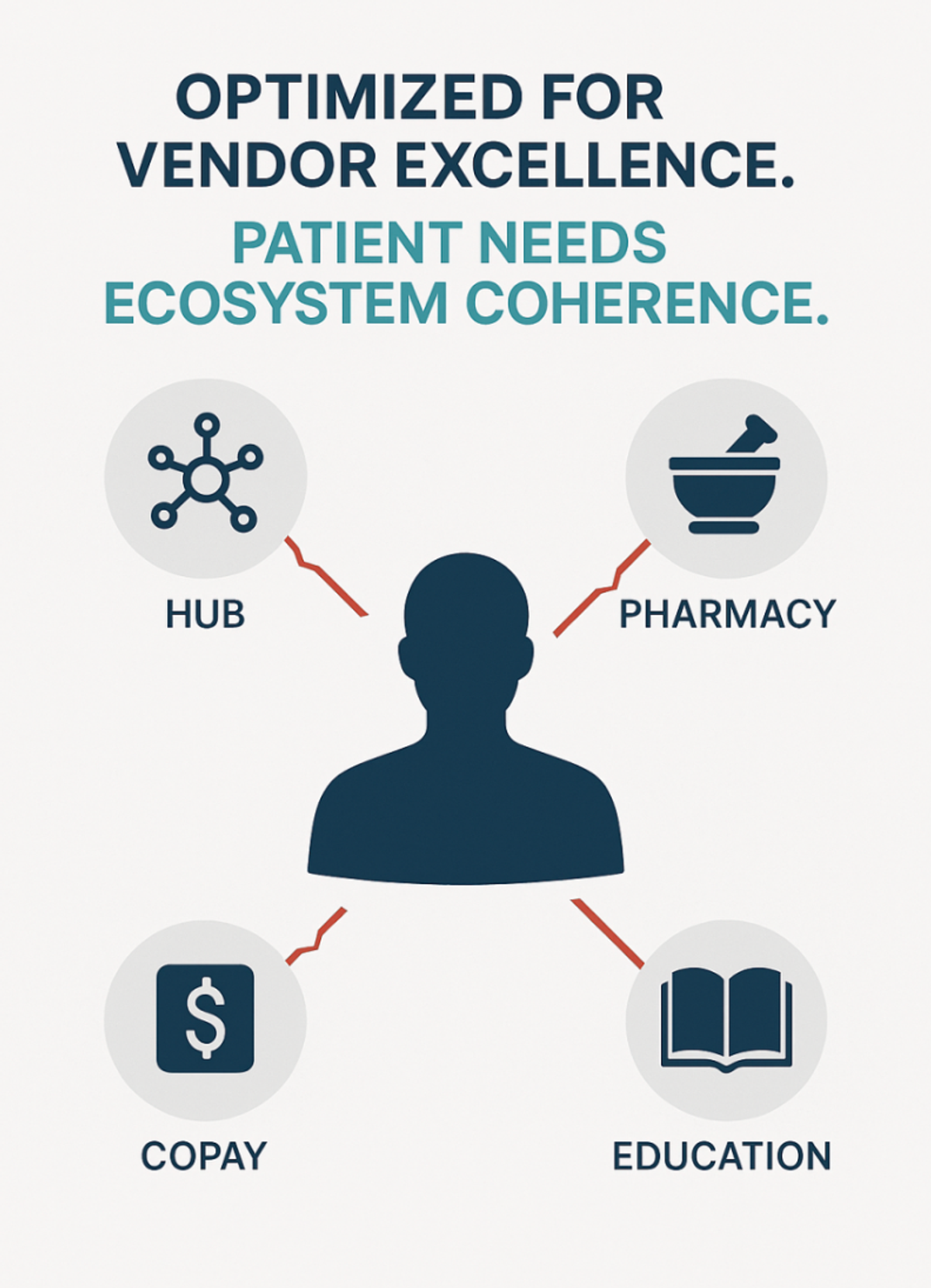
When autonomous AI can support thousands of patients in the 90%, but you're still paying per enrollment in the 10%, your business model is underwater.
A SaaS CFO's pricing model broke overnight when costs tripled while revenue flatlined.
Pharma's version: You spend millions building patient access hubs that only support 10% of what determines persistence. The enrollment call. Benefit verification. PA coordination. You excel at activation.
But patients make thousands of decisions in the 90%—at home, between appointments, alone. Your infrastructure doesn't touch it. Your pricing model doesn't capture it.
And this same mismatch between pricing models and AI economics just triggered a massive SaaS market correction.
Three trends are converging to make hub infrastructure a strategic issue, not just operational:
Value-based contracts tie reimbursement to real-world outcomes. Your success depends on persistence and adherence—metrics determined by what happens in the 90%. But your hub infrastructure only measures the 10%: enrollments, benefit investigations, PA completion rates.
Budget scrutiny on patient support ROI. CFOs are asking harder questions: What's our cost per persistent patient? How does our hub performance compare to competitors? Without outcome-based metrics, you're defending costs, not demonstrating value.
Patient experience matters more as therapies mature. When multiple treatment options exist, the brand that removes friction in the patient journey gains advantage. Your enrollment-focused infrastructure doesn't address where patients actually struggle.
Your next formulary negotiation will scrutinize real-world persistence data. The infrastructure you build now determines what data you can provide then. Timeline matters.
Agentic AI operates autonomously—making decisions and executing workflows without human input. In SaaS, one AI agent now handles work that previously required multiple human operators.
Applied to patient access:
Traditional hub model: Human coordinators handle every touchpoint—benefit verification, PA follow-up, refill coordination, patient questions. Each coordinator can meaningfully support a limited number of active patients.
AI-enabled model: Autonomous agents handle repetitive, high-volume tasks—verification status updates, refill coordination, routine scheduling. Human coordinators focus exclusively on complex cases requiring clinical judgment or personalized problem-solving. The same team can support meaningfully more patients.
This isn't cost reduction. This is business model transformation.
The SaaS pricing collapse followed predictable patterns. Patient access hubs have similar structural vulnerabilities:
Fixed cost per investigation, regardless of complexity or automation potential. As AI capabilities advance in navigating payer systems and drafting standard PA letters for clinical review, the labor component could compress significantly—yet pricing models remain tied to legacy workflows.
Pricing based on scheduled touchpoints—quarterly calls, monthly campaigns. Emerging AI capabilities can monitor patient interactions continuously, detect adherence signals in real-time, and trigger personalized interventions at scale—a fundamentally different value proposition than periodic human outreach.
Revenue tied to one-time training and scheduled follow-ups. AI-powered support systems can field patient questions around the clock and provide treatment-stage-specific guidance—capabilities that don't fit per-session pricing models.
Pharma typically measures 10% metrics: enrollment rates, time to first dose, call volume.
What could matter more:
This is friction mapping applied to hub economics.
The SaaS industry learned you can't bolt AI onto outdated business models. Patient access requires the same fundamental rethinking.
This isn't about adding features to your hub. It's about designing patient engagement infrastructure that addresses the 90% of the journey where persistence is actually determined.
Linked Patient Learning helps biopharma companies design this infrastructure through three core programs:
Patient Engagement Infrastructure (90/10 Framework)
We design strategic frameworks that address the 90% of patient experience—from diagnostic acceleration through sustained support—integrating digital tools and AI platforms where they create maximum value, not just where they're technically possible.
Ecosystem & Stakeholder Mapping
We map all stakeholders (HCPs, advocacy, payers, health systems) and identify intervention points that drive patient access and outcomes across the full ecosystem.
Measurement & Business Case Development
We create frameworks that connect engagement infrastructure to measurable clinical and business outcomes—the data your CFO and payers will demand.
We design the strategy, integrate the technology, measure the impact.
Schedule a 30-minute consultation.
We’ll discuss where your patient journey is breaking down and whether the 90/10 framework can help you rethink your patient engagement infrastructure.
Written by
Liza Prettypaul-Lodhia
Share your details and we'll send you the playbook.