
Loading Experience
Linked Patient Learning
Loading Experience
You know what the 90/10 Framework is.
The 10%: Activation moments—enrollment, benefit verification, first fill, training.
The 90%: Sustained support—daily decisions, coverage transitions, side effects, life disruptions, handoff coordination.
You understand the problem: Your infrastructure was built for the 10%. Patients discontinue in the 90%. You can't see it happening until it's too late.
You've seen the evidence: Board meetings where you can't explain declining persistence. Payer negotiations where you lack outcomes data. Vendor dashboards showing excellent metrics while patients disappear in the gaps.
You get it. So why haven't you started?
The Real Obstacles
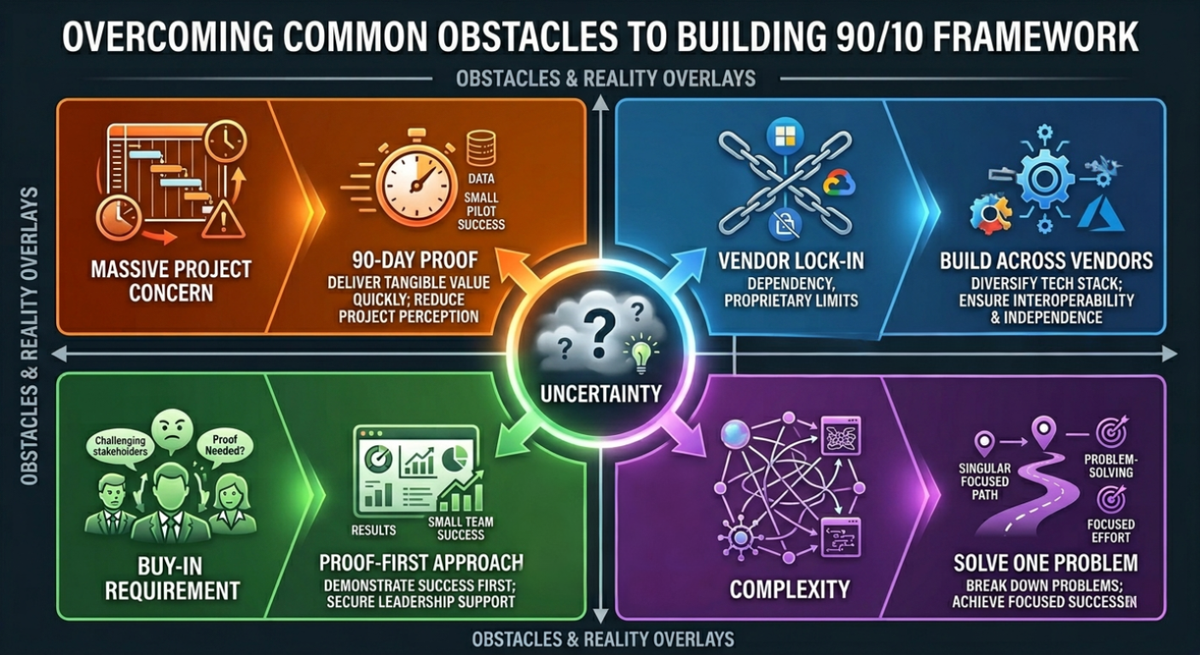
"This Feels Like a Massive Project"
You think: 18 months, $2M, executive approval you don't have.
Reality: You can prove the hypothesis in 90 days. Map one patient journey. Track root cause for one quarter. Test coverage monitoring on 100 patients. No budget approval. No new vendors. Just data you already have, used differently.
The "massive project" comes AFTER you prove it works.
"I'm Locked Into Current Vendors"
Your hub scored 3 out of 12. Your pharmacy can't see coverage gaps. You think: "I'm stuck until contracts renew."
What's actually happening: Your vendors aren't the problem. They're good at their piece. The problem is what happens BETWEEN vendors—handoffs no one owns, transitions no one monitors, journeys no single vendor sees.
Build infrastructure that works ACROSS vendors. Keep them for what they do well. Add the orchestration layer they weren't designed to provide.
"I Need Buy-In First" / "We're Too Overwhelmed"
You need CFO buy-in. CEO support. Board understanding. And you're drowning in launches, negotiations, submissions.
You need answers: You're overwhelmed because you manage symptoms, not root cause.
Every quarter: Board asks why persistence declines. Payers demand outcomes data you don't have. Vendors show excellent metrics while persistence drops.
That's recurring work with no resolution. 90% infrastructure eliminates firefighting by making the invisible visible.
Quick proof builds the business case. Journey mapping shows WHERE patients fail. Root cause shows WHY. Coverage pilots prove intervention works.
You don't need buy-in to map one journey. You need buy-in to SCALE.
"I Don't Know Where to Start"
The framework is comprehensive: ecosystem mapping, vendor integration, early warnings, root cause, proactive intervention, board presentations, payer data.
Start here: Solve ONE problem causing the most pain.
One problem. Prove it. Expand.
What These Obstacles Reveal
None of these are about resources, timing, or authority.
They're about uncertainty:
Here's what's true about that uncertainty:
It's valid. It's rational. It's also permanent.
The companies building proof right now aren't more certain than you. They just decided proof matters more than certainty.
How You Eliminate Uncertainty
You don't eliminate it through planning. You eliminate it through proof.
Map one journey: Does it reveal unknown gaps?
Track root cause for 30 days: Does it transform board presentations?
Monitor 100 patients: Does early intervention prevent discontinuation?
After 90 days, uncertainty becomes clarity.
What Building for the 90% Delivers
Board meetings: "Why is persistence declining?" becomes "35% coverage disruption, 25% access barriers, 20% financial stress. Here's our intervention impact."
Payer negotiations: You demonstrate 80% maintained therapy with early intervention vs. industry 35% reactive recovery.
Competitive positioning: When RFPs ask for "therapeutic continuity infrastructure," you have answers competitors don't.
Launch planning: You design around patient journey needs, not vendor capabilities.
This isn't theoretical. It's what infrastructure for the 90% delivers.
The Question That Matters
Is "waiting for certainty" actually strategy?
Or just deciding to accept declining persistence as something that happens to you?
The gap between understanding and building isn't resources. It's deciding that proof matters more than certainty.
When you're ready to move from understanding to proof:
If you want help translating the framework into your context—which Quick Win, how to execute, how to use results—that's what we do.
Written by
Linked Patient Learning
Share your details and we'll send you the playbook.